Showing posts with label patent. Show all posts

Tuesday, February 10, 2026

Patent Prosecution in Malaysia: A Guide to Substantive Examination


Patent Prosecution in Malaysia: A Guide to Substantive Examination

1. Introduction: The Malaysian Patent Landscape

The protection of intellectual property rights, particularly patents, serves as a cornerstone for economic development and technological advancement in Southeast Asia. For a layperson or a client entering this jurisdiction for the first time, the Malaysian patent system offers a robust framework governed by the Patents Act 1983 and the Patents Regulations 1986, both of which underwent significant transformation via the Patents (Amendment) Act 2022. This article serves as an exhaustive guide to navigating the critical phase of patent prosecution known as "Substantive Examination."

Unlike copyright, which arises automatically upon creation, or trademarks, which protect brand identity, a patent is a state-granted monopoly for a technical invention. This monopoly is not given lightly. It must be "earned" through a rigorous process of scrutiny known as examination. In Malaysia, the Intellectual Property Corporation of Malaysia (MyIPO) acts as the regulatory gatekeeper. Their role is to ensure that a patent is only granted if the invention is novel (new to the world), involves an inventive step (not obvious to an expert), and is industrially applicable.

For the applicant, the prosecution process is not merely a bureaucratic hurdle but a strategic negotiation. The choices made regarding when to request examination, and whether to defer that request can determine not only the costs incurred but the very validity and enforceability of the final patent. The 2022 amendments have fundamentally altered this strategic landscape, removing the flexibility that once allowed applicants to indefinitely pause their applications. Today, the system demands proactive management and a clear understanding of strict statutory deadlines.

This article will dissect the mechanisms of Substantive Examination, analyze the new restrictions on deferment, and provide a roadmap for managing the critical 18-month or 4-year deadlines that define the pulse of a Malaysian patent application.


A substantive examination is the critical "make or break" phase of the patent application process where a patent examiner conducts a rigorous technical and legal review of your invention. Unlike the initial formal examination—which just checks if you filled out the paperwork correctly—this stage dives into the actual essence of your claims to determine if the invention deserves a legal monopoly. The examiner searches global databases for prior art (any existing evidence that your invention was already known) to ensure the application isn't overstepping its bounds or claiming something that already exists.


2. What Do Examination Covers: The Patentability Requirements

To pass this phase, the examiner verifies that your application meets several strict legal criteria:

  • Novelty: The invention must be "new." If even a single piece of prior art shows your exact invention before your filing date, it fails this test.
  • Inventive Step (Non-Obviousness): This is often the highest hurdle. The examiner checks if your invention would have been "obvious" to a person having ordinary skill in the art (PHOSITA). It shouldn’t just be a logical next step or a simple combination of two known things.
  • Industrial Applicability: The invention must be capable of being made or used in some kind of industry. It cannot be purely theoretical or a violation of the laws of physics (like a perpetual motion machine).
  • Sufficiency of Disclosure: You must describe the invention clearly enough that someone else in your field could actually build and use it based solely on your written description.
  • Clarity and Conciseness: The "claims"—the specific legal boundaries of your invention—must be clearly defined so the public knows exactly what they are prohibited from infringing upon.


3. The Architecture of Patent Deadlines

In the realm of patent law, time is the most unforgiving variable. A missed deadline typically results in the irrevocable loss of rights. To understand the strategy of examination, one must first master the timeline that governs a Malaysian patent application. This timeline varies significantly depending on the route of entry: the Direct National Filing or the PCT National Phase Entry.

3.1 The Direct National Filing Route

A "Direct" filing occurs when an applicant files a patent application directly with MyIPO, without going through the international Patent Cooperation Treaty (PCT) system. This often happens when a Malaysian company files locally first, or a foreign company files in Malaysia claiming priority under the Paris Convention within 12 months of their home filing.

For these applications, the clock ticks rapidly. The most critical deadline for prosecution is the request for examination.

The 18-Month Guillotine

Under the Malaysian system, a request for substantive examination must be filed within 18 months from the filing date of the application. This is a distinct departure from many other jurisdictions where the examination deadline is calculated from the "priority date" (the date of the first filing abroad). In Malaysia, the countdown starts from the moment the application lands at MyIPO.

  • The Calculation: If an application is filed on January 1, 2024, the deadline to request examination is July 1, 2025.
  • The Pressure: This 18-month window is relatively short. In many cases, if the applicant has filed a corresponding application in the US or Europe, those foreign patent offices may not have issued a search report or examination result within 18 months. This forces the direct applicant in Malaysia to make a "blind" decision—investing in the Malaysian examination process before knowing if the invention is truly patentable globally.

3.2 The PCT National Phase Route

The Patent Cooperation Treaty (PCT) is a unified procedure for filing patent applications to protect inventions in each of its contracting states. A patent applicant who files a "PCT application" gets a significant extension of time before they must enter the "National Phase" in individual countries like Malaysia.

The 4-Year Strategic Window

For applications entering Malaysia via the PCT route, the deadline to request substantive examination is 4 years (48 months) from the International Filing Date.

  • The Calculation:
    • International Filing Date: January 1, 2020.
    • National Phase Entry Deadline (30 months): July 1, 2022.
    • Examination Request Deadline (48 months): January 1, 2024.
  • The Advantage: This timeline offers a massive strategic advantage. By the time the 4-year mark arrives, the applicant has likely received the corresponding Clear Examination Report from the “Prescribed Countries” (Australia, UK, Japan, Republic of Korea, USA, and the European Patent Office).

3.3 Visualizing the Deadlines

The following table contrasts the critical dates for a layperson to visualize the urgency difference between the two routes.

Milestone

Direct National Filing

PCT National Phase Entry

Trigger Event

Filing Date in Malaysia

International Filing Date (PCT Filing)

Priority Deadline

12 months (to claim foreign priority)

N/A (Already claimed in PCT)

National Entry Deadline

N/A

30 months from Priority Date

Exam Request Deadline

18 Months from Filing

48 Months from International Filing

Consequence of Miss

Application Deemed Withdrawn

Application Deemed Withdrawn

3.4 The Consequences of Inaction: "Deemed Withdrawn"

If the 18-month or 4-year deadline passes without a request for examination (Form 5) or a request for deferment (Form 5B, only for MSE), the application status changes to "Deemed Withdrawn".


4. The Examination Dichotomy: Standard vs. Modified

Once the applicant decides to proceed, they face a pivotal choice. Malaysia operates a dual-track examination system. The applicant must choose between Substantive Examination (SE) and Modified Substantive Examination (MSE). This choice is not merely procedural; it dictates the scope of the patent, the speed of the grant, and the future defensibility of the rights.

4.1 Standard Substantive Examination (SE)

The Mechanism: Standard SE is the traditional route. It involves a full, independent review by a MyIPO examiner. The examiner conducts their own search of the prior art (existing technology) and assesses whether the invention meets the Malaysian requirements for novelty, inventive step, and industrial applicability.

The Obligation to Disclose (Form 5): Even though SE is an independent review, the Patents Act places a burden on the applicant to assist MyIPO. When filing Form 5, the applicant must provide information regarding corresponding applications filed in "Prescribed Countries" (Australia, UK, Japan, Republic of Korea, USA, and the European Patent Office).

  • Applicants must submit the status of these applications, specifically any search results or patent numbers if granted.
  • Strategic Note: This does not mean the Malaysian examiner will blindly follow the US or UK examiner. They may disagree. However, they use the foreign search results as a starting point to avoid duplicating work.

When to Choose SE:

  1. No Foreign Grant Exists: If the application is unique to Malaysia or the foreign applications are still pending/rejected, SE is the only option.
  2. Divergent Claims: An applicant may want broader claims in Malaysia than were allowed in the US or Europe. For example, the US might have cited a piece of "prior art" that is not valid in Malaysia (due to different grace period rules). SE allows the applicant to argue for broader protection based strictly on Malaysian law.
  3. Independence: A patent granted via SE is standalone. It is harder for a competitor to attack it solely based on the invalidation of a foreign patent.

4.2 Modified Substantive Examination (MSE)

The Mechanism: MSE is a streamlined route designed to facilitate the grant of patents that have already been vetted by major patent offices. It is based on the principle of reliance. If a patent has already been granted for the same invention in a "Prescribed Country" (AU, UK, JP, KR, US, EP), MyIPO allows the applicant to request MSE.

The Requirement (Form 5A):

To file for MSE, the applicant submits Form 5A along with a Certified Copy of the foreign patent.

  • The Catch: The claims in the Malaysian application must be amended to be "substantially the same" as the claims in the granted foreign patent. This is a strict conformity requirement. If the US patent was granted with 5 narrow claims, the Malaysian application must be amended to match those 5 narrow claims.

When to Choose MSE:

  1. Cost Efficiency: The official fee for MSE (RM 640) is significantly lower than SE (RM 1,100). Furthermore, professional fees are often lower because the patent agent does not need to draft complex responses to examiner objections; the process is largely administrative.
  2. Speed: Since the substantive patentability question has already been settled abroad, MyIPO examiners typically process MSE requests much faster, often leading to a grant within 12-18 months of the request.
  3. Simplicity: It avoids the risk of a Malaysian examiner finding new prior art that the US examiner missed.

4.3 Comparative Analysis: Pros and Cons

Feature

Standard Substantive Examination (SE)

Modified Substantive Examination (MSE)

Official Form

Form 5

Form 5A

Official Fee

RM 1,100

RM 640

Prerequisite

None (can be first filing)

Must have a granted patent in AU, US, UK, JP, KR, or EP

Claim Scope

Flexible (Independent of foreign results)

Strict (Must match foreign grant)

Speed

Slower (Full search & exam)

Faster (Administrative check)

Risk Factor

Examiner may find new objections.

Tied to foreign patent's fate. If foreign patent is weak, Malaysian patent is weak.

Strategic Warning: Clients must be wary of the "MSE Trap." If a foreign patent is used as the basis for MSE, and that foreign patent is later revoked in its home country (e.g., via Inter Partes Review in the US), the Malaysian patent remains valid technically, but the groundwork of its grant is compromised. A savvy competitor might use the same arguments that killed the US patent to invalidate the Malaysian patent in court. SE provides a layer of insulation against this domino effect.


5. The 2022 Amendment: The New Deferment Regime

Perhaps the most critical update for any client entering the Malaysian market in 2024-2025 is the drastic change in deferment rules introduced by the Patents (Amendment) Act 2022. Prior to March 18, 2022, the system was forgiving. Applicants could request to defer any examination (SE or MSE) for almost any reason, often buying years of time to delay costs.

This option has been abolished. The new regime reflects a policy shift towards efficiency and reducing backlog. MyIPO now demands that applicants commit to the prosecution process unless there is a specific, statutorily valid reason to wait.

5.1 The Abolition of SE Deferment

Under the amended Section 29A(6) of the Patents Act, deferment of the filing of a request for examination is now only available for Modified Substantive Examination (MSE).

  • The Implication: An applicant cannot request to defer a Standard Substantive Examination (Form 5).
  • The Deadlines are Absolute: The 18-month (Direct) and 4-year (PCT) deadlines for Form 5 are now hard ceilings. You cannot file a "Form 5B" to delay a standard exam request simply because you are short on funds or undecided on strategy. You must file the request or lose the application.

5.2 The MSE Deferment Exception (Form 5B)

The legislature recognized a practical problem: MSE requires a foreign grant. Foreign patent offices (especially the USPTO or EPO) can take 3, 5, or even 7 years to grant a patent. If the Malaysian deadline is 4 years, an applicant might be forced to abandon the MSE route simply because the US office is slow.

To solve this, deferment is still permitted for MSE candidates.

  • The Mechanism: The applicant files Form 5B (Request for Deferment).
  • The Justification: The applicant must declare that they are waiting for a patent to be granted in a Prescribed Country for the same invention.
  • The Fee: RM 150.
  • The Result: The deadline to request examination is extended to 5 years from the Malaysian Filing Date (or International Filing Date).

5.3 The "Switch" Safety Net: Regulation 27B

A common strategic fear arises: "I deferred my Malaysian application to Year 5, waiting for a US patent. But at Year 4.9, the US patent is rejected. Now I can't file MSE, and I missed the deadline for SE. Is my application dead?"

The 2022 Amendments anticipate this. Regulation 27B introduces a "switch" mechanism or grace period.

  • The Rule: If an applicant deferred filing for MSE but, by the end of the deferment period (5 years), the foreign patent has not been granted or is not available, the applicant may file a request for Standard Substantive Examination (Form 5).
  • The Window: This request must be filed within 3 months from the expiry of the deferment period.
  • The Procedure:
    1. Deferment expires (e.g., at Year 5).
    2. Applicant realizes no foreign grant is coming.
    3. Applicant files Form 5 + Fee (RM 1,100) within the next 3 months.
    4. Prosecution proceeds as a normal, independent examination.

Strategic Pivot: This 3-month window acts as a crucial safety net. It allows applicants to gamble on the cheaper/faster MSE route without risking total loss if the foreign patent fails to materialize. However, this requires meticulous docketing. Missing this 3-month post-deferment window is fatal.


6. Strategies for Acceleration: PPH and Expedited Exam

For some clients, deferment is the opposite of what they need. Startups seeking venture capital, or companies facing infringement, often need a granted patent immediately. Malaysia offers two powerful acceleration tools: the Patent Prosecution Highway (PPH) and Expedited Examination.

6.1 The Patent Prosecution Highway (PPH)

The PPH is a work-sharing arrangement between MyIPO and other major patent offices. It allows MyIPO to reuse the positive search and examination results from a partner office to speed up the Malaysian process.

  • Partner Offices: MyIPO has PPH agreements with the Japan Patent Office (JPO), United States Patent and Trademark Office (USPTO), European Patent Office (EPO), China National Intellectual Property Administration (CNIPA), and the Korean Intellectual Property Office (KIPO).
  • How it Works:
    1. You receive a "Notice of Allowance" or a positive examination report in the US or Japan.
    2. You file a request for PPH at MyIPO (often concurrent with Form 5).
    3. You submit the claims allowed by the US/Japan office and a claims correspondence table showing how the Malaysian claims match.
  • The Benefit: The MyIPO examiner fast-tracks the application. While they are not legally bound to grant it, the existence of a positive foreign report makes acceptance highly likely and significantly faster (often reducing the wait from years to months).

6.2 Expedited Examination (Rule 27E)

If an applicant does not have a foreign grant (and thus cannot use PPH), they can pay for speed via the Expedited Examination provision.

  • The Cost: This is the premium option.
    • Form 5H (Request for Approval): RM 250.
    • Form 5I (Expedited Exam Fee): RM 2,800. (Total: RM 3,050 vs RM 1,100 for standard).
  • The Criteria: Acceleration is not granted on demand; it must be justified on specific grounds:
    1. National Interest: The invention relates to national security or public health.
    2. Green Technology: The invention promotes environmental sustainability.
    3. Infringement: There is evidence that a third party is infringing or preparing to infringe the invention.
    4. Commercialization: The applicant needs the grant to secure funding or commercialize the product within 2 years.
    5. Government Grants: The patent is a requirement for a university or research grant.
  • The Trade-off: Speed cuts both ways. While the examiner issues a report quickly (often within 4 weeks of approval), the applicant is also placed on a "shot clock." The response time to examiner objections is shortened (e.g., to 3 weeks), requiring the legal team to be highly responsive.

7. Financial Planning: Fee Schedules and Management

Navigating the patent system requires budget forecasting. The costs involve Official Fees (paid to the government) and Professional Fees (paid to the patent agent). While professional fees vary, official fees are statutory.

7.1 Comprehensive Official Fee Schedule (2024/2025)

The following table details the key costs associated with examination and deferment management.

Action

Form No.

Official Fee (RM)

Strategic Note

Request for Substantive Exam

Form 5

1,100.00

Standard route.

Request for Modified Exam

Form 5A

640.00

Requires certified foreign grant.

Deferment of MSE Request

Form 5B

150.00

Extends deadline to 5 years.

Request for Expedited Exam

Form 5H + 5I

3,050.00

(250 + 2800). For urgent cases.

Reinstatement of Lapsed Patent

Form 5E

150.00

Plus surcharges; high risk.

Voluntary Amendment

Form 5B/Other

varies

Can be filed to align claims.

Restoration of Priority

Form 1A

150.00

If 12-month priority missed.

Certificate of Grant

N/A

Included

No separate grant fee (usually).

Annual Renewal (Year 2)

N/A

290.00

Fees rise annually.

7.2 The Hidden Costs of "Deemed Withdrawn"

While the RM 150 fee for Form 5E (Reinstatement) seems low, the true cost of missing a deadline is much higher.

  1. Surcharges: Late payment often attracts a 100% surcharge on the original fee.
  2. Legal Costs: Proving "unintentional delay" requires drafting statutory declarations and affidavits, which incurs significant attorney fees.
  3. Risk of Loss: There is no guarantee MyIPO will accept the reinstatement. The cost of a lost patent is the potential loss of market exclusivity.

8. Strategic Case Studies

To contextualize these rules, we examine two hypothetical scenarios for a layperson client.

Case Study A: The "Tech Giant" (US-First Strategy)

Profile: A US software company files a PCT application, then enters Malaysia. They have a pending US application.

  • Timeline:
    • PCT Filing: Jan 2020.
    • Malaysia Entry: July 2022 (30 months).
    • Exam Deadline: Jan 2024 (48 months).
  • Dilemma: By Jan 2024, the US patent is not yet granted.
  • Strategy:
    1. File Form 5B (Deferment) before Jan 2024. Pay RM 150.
    2. This extends the deadline to Jan 2025 (5 years from filing).
    3. Scenario 1: US Patent grants in Dec 2024. -> File Form 5A (MSE) immediately.
    4. Scenario 2: US Patent still pending in Jan 2025. -> Utilize Regulation 27B. File Form 5 (SE) within 3 months (by April 2025). The application proceeds to full examination, ensuring it is not lost.

Case Study B: The "Local SME" (Direct Filing)

Profile: A Malaysian manufacturing company files directly with MyIPO.

  • Timeline:
    • Filing: Jan 2024.
    • Exam Deadline: July 2025 (18 months).
  • Constraint: Limited budget.
  • Strategy:
    • The SME cannot defer. Form 5B is not available because they have no foreign application to rely on.
    • They must file Form 5 (RM 1,100) by July 2025.
    • Cost Saving Tip: If the SME decides to abandon the application, the SME could save the RM 1,100 fee and future prosecution costs.

9. Conclusion: The New Rules of Engagement

The Malaysian patent system has evolved from a flexible, permissive regime to one that prioritizes efficiency and decisiveness. For the client new to this jurisdiction, the key takeaways are clear:

  1. Deadlines are Rigid: The 18-month (Direct) and 4-year (PCT) deadlines are the single most critical dates in the prosecution lifecycle.
  2. Deferment is Restricted: You can no longer buy time for a standard examination. Deferment is exclusively a tool for those waiting to use the cheaper Modified Examination (MSE) route.
  3. The Safety Net Exists: The Regulation 27B "switch" mechanism allows you to aim for MSE but fall back on SE if foreign grants are delayed—but only if you act within the strict 3-month window.
  4. Speed is Available: PPH and Expedited Examination offer viable paths for urgent commercial needs, provided the budget and documentation are in order.

Success in Malaysian patent prosecution requires not just invention, but procedural vigilance. By aligning your strategy with these statutory milestones, you ensure that your intellectual property remains a secured asset rather than a procedural casualty.


Disclaimer: This article provides general information based on the Patents Act 1983 and Regulations as of 2025. It does not constitute legal advice. Patent deadlines and fees are subject to change. Professional counsel from a registered Malaysian patent agent is strongly recommended for specific applications.


Tuesday, January 13, 2026

Don’t Be Fooled: How to Identify Unsolicited IP Services

It has come to our attention that several of our clients have recently received unsolicited letters and invoices regarding the renewal of their Intellectual Property (IP).

Please be aware that these requests often come from private companies that are not affiliated with our firm.

How to spot these unsolicited notices: These notices are designed to look official. They often use names, acronyms, and formatting that mimic government correspondence. They may:

  • Create a false sense of urgency (e.g., "Your IP will expire immediately if not paid").

  • Demand payment of fees.

  • Imply that you must use their specific service to secure your rights.

Official Communication Channels Please remember that as your appointed patent and trademark agents, we track your deadlines and handle your renewals. If you receive a bill from a third party, do not pay it without verifying it first.

The Reality These companies are private entities. They have no authority over your IP rights. While they may technically offer to renew your IP, they may take your money without performing the renewal.


Our Advice You have already engaged us as your IP agents to manage your portfolio. We monitor your deadlines and will always notify you well in advance when a renewal is due.

If you receive a letter asking for payment:

  1. Do not pay.

  2. Check the sender. Is it from our firm? Is it from an official government email?

  3. Forward it to us. We can confirm if it is a legitimate requirement or a solicitation to be discarded.

Thursday, January 2, 2025

The Importance of Microorganism Deposits in Malaysia

Patents can cover isolated bacteria, fungi, algae protozoa, plasmids and prions. One area that often requires special attention is the deposit of microorganisms, especially when it comes to patent applications involving biotechnological inventions. In Malaysia, the process of depositing microorganisms is essential for several reasons, and there are specific institutions where these deposits can be made. 

Why Deposit Microorganisms?

  1. Patent Requirements: When filing a patent application for an invention involving microorganisms, it is often necessary to deposit the microorganism in a recognized depository. This is because microorganisms cannot be adequately described in a written patent application. The deposit ensures that the microorganism is available for examination and reproduction, which is a requirement under the Budapest Treaty.

  2. Preservation and Accessibility: Depositing microorganisms in a recognized depository ensures their long-term preservation and accessibility. This is crucial for scientific research and industrial applications, as it allows other researchers and companies to access the microorganism for further study and development.

  3. Compliance with International Standards: The Budapest Treaty on the International Recognition of the Deposit of Microorganisms for the Purposes of Patent Procedure mandates that all member states recognize a deposit made in any one of the international depositary authorities (IDAs). This means that a single deposit is sufficient for patent procedures in multiple countries, streamlining the process and reducing costs.

What is the Budapest Treaty?

The Budapest Treaty, established in 1977, is an international agreement that simplifies the process of patenting biotechnological inventions involving microorganisms. Under this treaty, a single deposit of a microorganism with any recognized IDA is sufficient for patent purposes in all member countries. This eliminates the need for multiple deposits in different countries, making the patent process more efficient and cost-effective. The treaty also ensures that deposited microorganisms are preserved and made available for examination and reproduction, which is essential for the patenting process.

Where to Deposit Microorganisms

In Malaysia, the Universiti Putra Malaysia Microbial Culture Collection (UPM-MCC) (open exernal link) has been officially acknowledged as the first National Depository Authority (NDA) for microorganisms. UPM-MCC provides essential research support services and offers bacteria storage services under the Patent Deposit category, meeting a key requirement for filing patents related to microorganisms.

Additionally, microorganisms can be deposited in any IDA (open external link) recognized under the Budapest Treaty. This includes various institutions worldwide that meet the standards set by the treaty, ensuring that the deposited microorganisms are preserved and accessible for patent examination and other purposes.

When selecting a depository for microorganisms, several factors come into play:

  1. Type of Microorganisms Accepted: Different depository accept various kinds of microorganisms. It's essential to verify whether the storage conditions of the depository can accomodate the specific type of microorganism you need to deposit.

  2. Foreign Patent Applications: If you are planning to file a foreign patent application, you must choose an IDA. Currently, UPM is not recognised as an IDA.

  3. Cost Considerations: The fees associated with depositing microorganisms can vary between depositories. Additionally, the logistics of transporting the microorganism can influence the overall costs. 

WIPO Standard ST.26 for Sequence Listing

Patent applications that include nucleotide and/or amino acid sequence listings must include the sequence listing in WIPO Standard ST.26 file format. WIPO Sequence is a global software tool that enables patent applicants to prepare amino acid and nucleotide sequence listings compliant with WIPO standard ST. 26 as part of a national or international patent application. This tool helps ensure that sequence listings are standardised. 

Conclusion

Depositing microorganisms is a crucial step in the patent application process for biotechnological inventions. It ensures compliance with international standards, preserves the microorganisms for future research, and makes them accessible for examination and reproduction. In Malaysia, UPM-MCC serves as a national depository, while IDA provide additional options for researchers and inventors seeking international protection. Patent applications that include sequence listings must be prepared according to WIPO Standard ST.26.

Wednesday, January 31, 2024

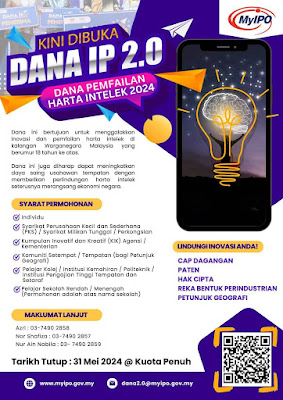
Dana IP 2.0 bagi 2024 telah Buka untuk Pemfailan Harta Intelek

Dana IP 2.0 bagi 2024 telah buka untuk permohonan harta intelek. Dana IP 2.0 adalah inisiatif yang dilancarkan oleh Perbadanan Harta Intelek Malaysia (MyIPO) untuk membantu usahawan dan penemu dalam memfailkan permohonan harta intelek (IP) di Malaysia dan luar negara. Dana IP 2.0 menawarkan bantuan kewangan bagi setiap permohonan IP yang layak, termasuk cap dagangan, paten, reka bentuk perindustrian dan hak cipta. Tujuan dana ini adalah untuk menggalakkan inovasi dan kreativiti di kalangan rakyat Malaysia, serta meningkatkan kesedaran dan penghargaan terhadap nilai IP.


Dana IP 2.0 mempunyai beberapa syarat kelayakan yang perlu dipenuhi oleh pemohon, antara lain:

- Pemohon mestilah warganegara Malaysia atau syarikat SME yang berdaftar di Malaysia.

- Pemohon mestilah mempunyai idea atau produk yang baru, asli dan berpotensi komersial.

Pemohon yang berminat boleh mengemukakan permohonan secara dalam talian melalui portal MyIPO di https://www.myipo.gov.my/en/dana-pemfailan-harta-intelek-dana-ip-2-en/ atau menghubungi talian khidmat pelanggan MyIPO di 03-2299 8400 untuk maklumat lanjut.

Dana IP 2.0 adalah peluang yang baik untuk usahawan dan penemu yang ingin melindungi hak mereka terhadap idea atau produk mereka, serta meningkatkan daya saing dan kebolehjalan mereka di pasaran tempatan dan antarabangsa. 

Boon IP merupakan sebuah syarikat yang menyediakan perkhidmatan pengurusan paten untuk pelbagai jenis projek inovasi. Syarikat ini telah berjaya membantu banyak pihak, termasuk institusi pendidikan, syarikat swasta dan individu, untuk mendapatkan pembiayaan dan perlindungan undang-undang bagi hasil kerja mereka. Antara contoh kejayaan Boon IP yang dapat kelulusan paten melalui Dana IP ialah: 

- Paten MY187491A Kolej Vokasional Slim River 'Lock Reminder for Motorcycle Steering'

- Paten MY187619A Institut Kemahiran Belia Negara Kuala Perlis 'An Apparatus for Holding Impact Wrench' 

- Paten MY197556A Institut Kemahiran Tinggi Belia Negara Temerloh 'Tool for Removal and Installation of Valve Pin'

- Paten MY185349A Noor Arjuna 'Device for Gripping and Storing Miswak Sticks'

Boon IP telah memberikan nasihat dan bantuan profesional dalam proses permohonan dan pendaftaran paten, tanpa mengenakan sebarang bayaran tambahan. Oleh itu, jangan lepaskan peluang ini dan mohon sekarang!

Monday, September 4, 2023

How Malaysia Plans to Achieve High-Tech Industrialization by 2030

Malaysia is a developing country that aims to become a high-tech industrialized nation by 2030. To achieve this goal, the government has launched the New Industrial Master Plan (NIMP) 2030, which outlines the strategies and actions to transform the country's industrial sector. 

The NIMP 2030 is different from the previous industrial master plans, as it adopts a mission-based approach that focuses on four key areas: advancing economic complexity, teching up for a digitally vibrant nation, pushing for net zero, and safeguarding economic security and inclusivity. 

Here are some of the highlights of the NIMP 2030 and what they mean for Malaysia's industrial development. 

Enhancing Economic Complexity

Economic complexity refers to the diversity and sophistication of a country's productive capabilities and exports. A higher economic complexity indicates a higher level of knowledge, technology and innovation in the economy.

The NIMP 2030 aims to increase Malaysia's economic complexity index (ECI) from 1.07 in 2021 to 1.5 by 2030, to be on par with developed countries.

To do this, Malaysia has identified several potential clusters that can be developed, such as electrical and electronics, machinery and equipment, aerospace, medical devices, renewable energy, biotechnology, halal products, and creative industries. 


Another key strategy is to increase the research expenditure to 3.5% of GDP by 2030, which would boost the innovation capacity and competitiveness of the industries. The plan also aims to strengthen the linkages between universities, industry and government to foster collaborative research and development.

One of the enablers for research and innovation is intellectual property (IP), which protects and rewards the creators of new knowledge and technology. The NIMP 2030 recognizes the importance of IP for industrial development and aims to improve the IP system in Malaysia.

Some of the initiatives include digitizing and accelerating IP applications; facilitating IP commercialization and monetization; and strengthening IP enforcement and protection.

Building SME's Capacity

Small and medium enterprises (SMEs) are the backbone of Malaysia's economy, accounting for 98.5% of business establishments, 38.9% of GDP, 48.4% of employment and 17.9% of exports in 2021.

The NIMP 2030 aims to enhance SMEs' capacity and resilience by helping them to upgrade their products, processes and business models; diversity their markets and customer segments; increase their productivity and efficiency; improve their quality and standards; adopt digitalization and automation; and integrate into regional and global value chains.

Some of the initiatives include providing technical assistance and advisory services; facilitating access to technology platforms and solutions; offering training and upskilling programs; and supporting branding and marketing activities.

Embracing ESG Principles

Environmental, social and governance (ESG) principles are a set of criteria that measure a company's performance on sustainability issues such as environmental protection, social responsibility, human rights, diversity, ethics and corporate governance. 

The NIMP 2030 aims to embrace ESG principles as a core value of Malaysia's industrial development by promoting green growth, social inclusion and good governance across all sectors and industries.


Ministry of Investment, Trade and Industry

Some of the initiatives include implementing low-carbon policies and measures; encouraging renewable energy generation and consumption; reducing waste generation and increasing recycling rates; enhancing environmental management and compliance; ensuring fair labour practices and decent work conditions; supporting social enterprises and community development; improving corporate transparency and accountability; combating corruption and fraud; and strengthening stakeholder engagement and participation.

Conclusion

The NIMP 2030 is a comprehensive and ambitious plan that aims to transform Malaysia's industrial sector into a high-tech, high-value and high-impact engine of growth for the country. By enhancing economic complexity, creating supportive ecosystems, building SME's capacity and embracing ESG principles, the plan hopes to achieve Malaysia's vision of becoming a high-tech industrialized nation by 2030.

Wednesday, January 19, 2022

Increasing Business Focus on Innovation Through Patent Portfolio

 Global organizations cite patent innovation as key to increasing competitive advantage amidst the pandemic

LONDON, Jan. 18, 2022 /PRNewswire/ -- Clarivate Plc (NYSE: CLVT), a global leader in providing trusted information and insights to accelerate the pace of innovation, today released a new report which highlights global insights into how organizations are using patents and patent data, challenges and opportunities, and the role of patents in driving the lifecycle of innovation.

(PRNewsfoto/Clarivate Analytics)

As revealed in the Clarivate™ Patent Trend Report 2022, the organizations surveyed overwhelmingly view patents as a business driver, with the majority (75%) saying the primary purpose of their patent strategy is to enable further innovation. The results also show that the majority (69%) of patent portfolios have increased in the last 12 months, driven by increases in budget, greater C-suite buy-in and changes in business focus.

Key findings include:

  • Nearly half of respondents (45%) say their organizations have missed out on opportunities because the C-Suite was not engaged with their patent strategy.
  • More than half (57%) also say it has become harder to implement their patent strategy in the last 12 months with the top reasons being insufficient staff, data, budget and time.
  • Many are turning to outsourcing, with 45% already outsourcing between 26% to 50% of their patent activities.
  • Nearly half (44%) saying they will outsource more in the next 12 months.

There is positive change on the horizon, as these organizations say they think technology could provide better data analytics capabilities, better efficiency to enhance productivity and a real-time view of data. They also see AI adding the most value in patent analysis, search and licensing.

Gordon Samson, Chief Product Officer, Clarivate said: "The findings in this report reveal that patent protection and its role in the innovation lifecycle remain critical to businesses around the world. Despite the turbulent times faced over the course of the pandemic, organizations recognize the opportunities and value to be gained by usage of patent data. Clarivate is proud to be an experienced patent intelligence and lifecycle partner that can provide the insights to inform patent strategy – which could prove key to successfully navigating ongoing uncertainty and accelerating innovation in organizations around the world."

Methodology
Clarivate commissioned research into patent trends across key global regions, carried out by independent survey firm Vitreous World. The research sought the views of 275 IP and patent professionals, both in-house and external counsel, across seven countries/regions: the United States, United Kingdom, France, Germany, Mainland China, Japan and South Korea.

About Clarivate
Clarivate™ is a global leader in providing solutions to accelerate the lifecycle of innovation. Our bold Mission is to help customers solve some of the world's most complex problems by providing actionable information and insights that reduce the time from new ideas to life-changing inventions in the areas of science and intellectual property. We help customers discover, protect and commercialize their inventions using our trusted subscription and technology-based solutions coupled with deep domain expertise. For more information, please visit clarivate.com.

Media Contact
Rebecca Krahenbuhl, External Communications Manager
media.enquiries@clarivate.com 

Cision View original content to download multimedia:https://www.prnewswire.com/news-releases/clarivate-patent-trend-report-shows-increasing-business-focus-on-innovation-through-patent-portfolio-spend-301462632.html

SOURCE Clarivate Plc

Saturday, December 18, 2021

Patents (Amendment) Bill 2021 Approved - Patents Recognized as Personal Property

  • Deposit of microorganism under Budapest Treaty
  • Patents recognized as personal property
  • Opposition procedure introduced

On 15 Dec 2021, Alexander Nanta Linggi, the Minister of Domestic Trade tabled a Bill to amend the Patents Act 1983 in Dewan Rakyat, the lower house of the parliament. The first reading was made two days earlier.

Alexander Nanta Linggi


Parlimen Malaysia

We have compiled YouTube sessions of the tabling, debate and passing of the bill.

[2:39:14] Tabling of Patents (Amendment) Bill 2021 for Second Reading. The text of the Bill in English and Malay.

[3:15:20] Debate by Members of Parliament: Choong Shiau Yoon (Tebrau), Shaharizukirnain (Setiu), Wong Hon Wai (Bukit Bendera), Mohamed Hanipa (Sepang), Nurul Izzah (Permatang Pauh), and Cha Kee Chin (Rasah).

Alexander stated that patents would be recognized as a personal property, hence, patents can be mortgaged at financial institutions. He also explained that IP Journal is chosen to publish granted patents instead of Government Gazette to speed up the registration of patents.

Alexander added that compulsory licensing allows the government to address public health issues involving medicine. On the other hand, Budapest Treaty is acknowledged to formalize an international mechanism to recognize inventions involving microorganisms. Applicants would need to deposit microorganisms once to enjoy patent recognition among members of the treaty.

He announced that an IP Fund of RM1 million annually is allocated to encourage IP filings among SMEs, polytechnic, students and youth.

Third party observation and opposition is introduced in the amendment to strengthen the quality of patents. In line with developed countries, third parties can participate in the patent application process.

The amendments took into consideration Malaysia's commitment in the Agreement on Trade-Related Aspects of Intellectual Property (TRIPS) relating to public health, Regional Comprehensive Economic Partnership (RCEP)  and Progressive Agreement for Trans-Pacific Partnership (CPTPP).

[4:08:21] The second reading of the Bill was agreed. The Bill was tabled again for third reading and passed.

There are 69 clauses in the Bill which would need to be tabled in Dewan Negara, the upper house of parliament. We will provide our commentary on the amendment in the future. Stay tuned!

- 22 Dec 2021 update -

On 22 Dec 2021, Rosol Wahid, the Deputy Minister of Domestic Trade tabled the Bill to amend the Patents Act 1983 in Dewan Negara, the upper house of the parliament. 

Parlimen Malaysia

[58:33] Tabling of Patents (Amendment) Bill 2021 for Second Reading.

[1:05:46] Debate by Members of the Senate: Razali Idris and Mohd Apandi.

[1:31:44] The second reading of the Bill was agreed. The Bill was tabled again for third reading and passed.

** The Patents (Amendment) Act 2022 is in force since 18 Mar 2022 **

Monday, April 26, 2021

Building value and growth for small businesses

By Julian Crump, President of the International Federation of Intellectual Property Attorneys (FICPI)

There's a myth that protecting intellectual property (IP) is the preserve of larger firms and is unsuited to smaller and medium-sized enterprises (SMEs).

While large companies invest in IP for good reasons – to protect their products and services, discourage competition and create new revenue streams for themselves – IP undoubtedly benefits smaller businesses too.

SMEs that apply for patents, trademarks or designs are more likely to grow quickly and succeed than those that do not.

In fact, the evidence is that SMEs that apply for patents, trademarks or designs are more likely to grow quickly and succeed than those that do not.

A 2019 EPO/EUIPO study pdf demonstrated that SMEs that have at least one IP right are 21 percent more likely to experience a growth period. Meanwhile, a 2021 update to the study found that fewer than 9 percent of SMEs owned at least one of the three main IP rights (a patent, trademark and design). By contrast, the figure is close to 60 percent for larger firms. This reveals a shocking disparity in the use of such a valuable business tool.

The value SMEs gain from protecting their IP assets comes in many forms

As well as serving as the current president of FICPI, I am a Chartered UK and European Patent Attorney, and a partner in the firm of Abel + Imray in London, Bath and Cardiff, UK and Spain. To look for examples of SMEs that use IP protection as a key element of their business success, my partners and I reviewed our list of clients.  We did not have to look far.

Several years ago, aircraft seating designers Acumen Design Associates moved from a consultancy model (with revenue based on project fees), to also creating their own designs, which are then patented. Today, a major part of Acumen’s revenue comes from issuing licenses for the use of their protected designs. (Photo: Courtesy of Acumen Design Associates)

The results are instructive and hugely encouraging for other SMEs:

  • Growing license sales and royalty revenue - Several years ago, market-leading aircraft seating designers Acumen Design Associates, led by founder Ian Dryburgh, moved from a consultancy model, with revenue based on project fees, to also creating their own designs, which are then patented. Today, a major part of Acumen’s revenue comes from issuing licenses for the use of their protected designs - including a large deal in 2016 with United Airlines for business class seating.

  • Winning venture capital (VC) funding XYZ Reality Ltd., has won numerous accolades for a highly accurate, “engineering grade” augmented reality (AR) solution which ensures building construction matches exactly the architects’ drawings. Their solution avoids problems with traditional site setting-out methods and penalties for errors. The patent application was complicated, involving multiple disciplines from advanced engineering to AR and physics. A positive opinion on the application from the European Patent Office (EPO) helped XYZ Reality secure venture capital (VC) funding.

Over and above the underlying product or service it protects, IP is a valuable asset in its own right. Indeed, it can become a company's most valuable asset.

  • Making SMEs more valuable for acquisition - Siltbuster Limited is recognized as the UK’s top provider of on-site water treatments and is a winner of the Queen’s Award for Enterprise. A big factor in its success has been the patenting of breakthroughs by the company’s founder, Dr Richard Coulton, who began with a vision of treating concrete wastewater at construction sites in a more environmentally friendly way. In 2018, the technology caught the eye of Workdry International, which ended up purchasing Siltbuster – and its IP.

  • From university research to university spin-out - A research project at University College London investigating how to transfect cells using siRNA morphed into a small company, NanoGenics Limited. A few years – and several research cycles – later, NanoGenics developed LipTide® to target selected genes and better combat cancer. The company sold the associated IP rights for GBP 4.5 million (approx. USD 6.2 million), helping their cutting-edge medical development advance to commercialization.

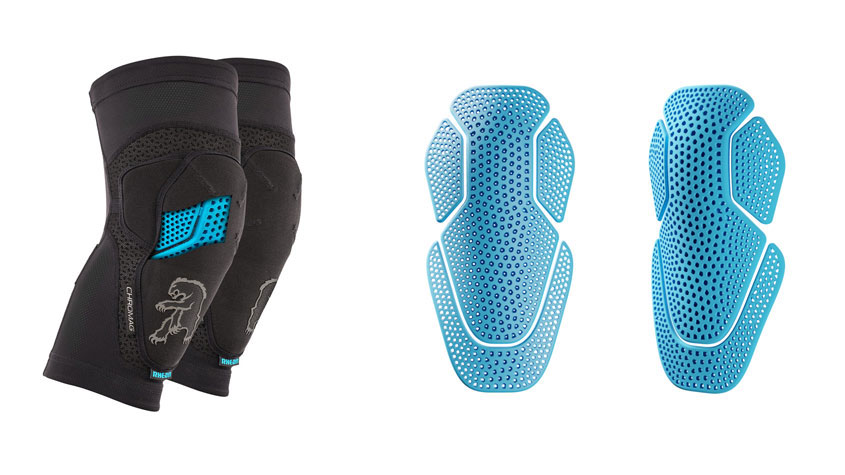
  • Using trade secrets to stay under competitor radar - Today, Rheon Labs Ltd., which makes protective body wear for high-impact sports, is a strategic and sophisticated user of IP. Initially, they relied on trade secrets to protect selected aspects of their IP, staying under their competitors’ radars (rather than filing patent applications, which are automatically published after 18 months). However, once others started encroaching on their field, Rheon Labs pivoted to patenting. This put their technology into the public domain, but in return they gained 20 years of exclusivity and their competitors must now devise their own new and inventive products if they wish to secure their own patents.
Rheon Labs Ltd., who make protective body wear for high-impact sports, is a strategic and sophisticated user of IP. (Photo: Courtesy of Rheon Labs Ltd.)
  • Trademarks to underpin commercial partnerships - The Rheon Labs® trademark was registered early, when pre-filing searches indicated there were few third-party rights that might prevent its use. As the company grew and moved into the realm of collaborations and commercial partnerships, water-tight non-disclosure agreements (NDAs) and design registrations were added to its IP estate. Rheon Labs® now has strong brand recognition, and the company benefits from valuable goodwill in its name. Registration serves to lock in that value, provides a visible sign of ownership, and facilitates co-branding with partners like Xenith LLC, a top American football helmet manufacturer, whose products now carry the Rheon Labs® trademark, and are recognized for reducing concussive impacts and associated brain injuries, alongside their own. Without registration and water-tight licensing arrangements, allowing a third party to apply your trademark to their goods would put you at risk of losing it. Registration typically protects a company’s marks for 10 years, but with the advantage that they can be renewed in perpetuity – as long as they don’t become generic terms.

  • Creating valuable IP assets to demonstrate market potential - Ceres Power is a company with patented "deep technology" that has a wide range of clean energy applications and has become a hugely valuable asset. However, had commercialization specialists, IP Group Plc, not stepped in at a critical moment, the company would likely have declared bankruptcy following the failure of initial field trials. IP Group works with early-stage companies that own IP originating from university research to get them to a point where they can demonstrate the real-world viability of their technology to attract co-investment from large corporates and ultimately acquisition. IP Group's Dr. Rob Trezona told me, "IP is a table stake. If our portfolio companies haven't secured their IP rights, they won't be able to raise finance. And typically, investors are looking for a number of patents rather than one or two." Key to IP Group’s successful turnaround of Ceres was the realization that its world-class IP position would allow it to generate more value as a technology provider that jointly develops and licenses technology than as a vertically integrated manufacturing business. The company has partnered successfully with Bosch, Doosan and Weichai Power to develop products for data centers, distributed generation and heavy road vehicles, and is able to generate value for itself through license fees and royalties.
NanoGenics Limited, an innovative, research-based gene therapy company, sold IP rights for its LipTide® therapy for GBP 4.5 million (approx. USD 6.2 million), helping their cutting-edge medical development advance to commercialization. (Photo: Courtesy of NanoGenics Ltd.)

These examples illustrate how, over and above the underlying product or service it protects, IP is a valuable asset in its own right. Indeed, it can become a company's most valuable asset. Without doubt, there will be countless other examples among the clients of other IP firms worldwide.

IP rights create a protective wrapper around an intangible asset – locking in value and making it tradeable, through licensing, pooling, securitization or acquisition. Without IPRs, investments made by companies in developing new products and processes, or even in simply devising new product ideas, are at risk. It's a bit like creating a beautiful garden without putting up a fence to keep the rabbits out!

Without the help of a specialist IP attorney, an SME is unlikely to be able to identify the important points of novelty or broad utility of their inventions, which are vital for a successful IP strategy, or may simply be defeated by the registration process.

Indeed, for SMEs, tackling IP protection can seem impossible. Seeking to obtain patent, trademark and design rights is complex. There are relatively few "self-filers", and of those few, the majority abandon their applications or are unsuccessful in gaining granted rights.

As a patent attorney, I obviously have a self-interest in pointing out the depth and sophistication of the services offered by independent IP professionals to SMEs.

IP rights create a protective wrapper around an intangible asset – locking in value and making it tradeable through licensing, pooling, securitization or acquisition.

However, given the stakes, the clear evidence that SMEs holding IP rights prosper relative to others that do not, and the all-too-frequent failure of SMEs to complete the application process on their own, the conclusion is clear.

SMEs should look to protect their IP assets to support and accelerate their growth by locking in the value of their IP and building intangible assets which can be used to underpin a wide variety of different business models, with innovation at their core.

Independent IP attorneys bring wide experience from advising a broad range of different clients. They can look beyond the immediate applications of an invention to focus on its points of novelty, giving the patents a longer useful life as the businesses they protect flex and adapt to new markets and are made more attractive to investors.

The investment an SME makes in partnering with an independent IP professional has a significant return, not only in terms of a successful application, but also for its future as the owner of IP rights.

XYZ Reality Ltd., has developed a highly accurate, “engineering grade” augmented reality (AR) solution which ensures building construction matches exactly the architects’ drawings. A positive opinion on the application from the European Patent Office (EPO) helped the company secure venture capital funding. (Photo: Courtesy of XYZ Reality Ltd.)
WIPO Magazine