Showing posts with label ASEAN. Show all posts

Monday, November 16, 2020

RCEP: No Term Extension for Patents and Copyright


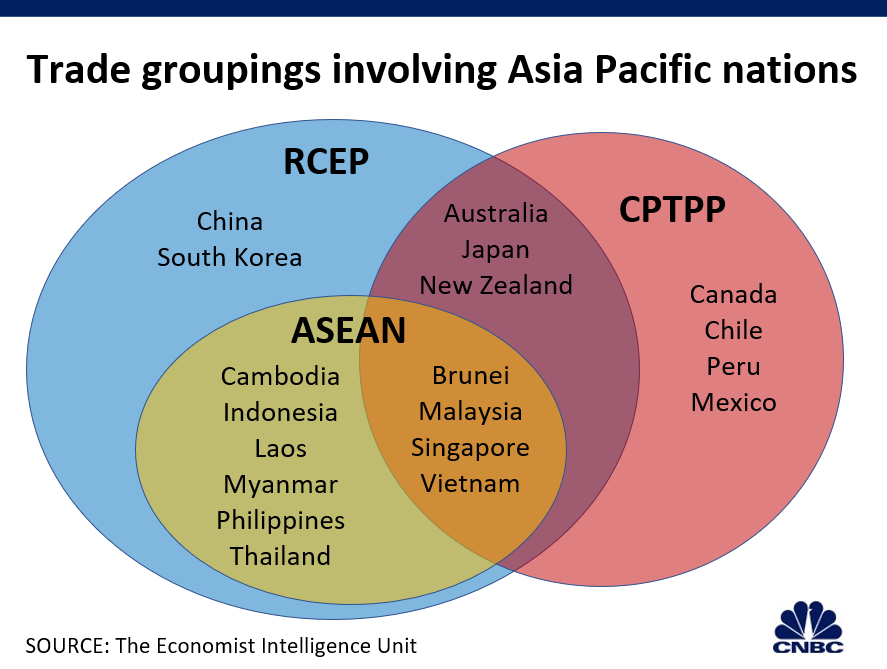
On 15 Nov 2020, Malaysia signed the Regional Comprehensive Economic Partnership (RCEP) along with 9 ASEAN members, Japan, China, South Korea, Australia and New Zealand. It is the largest regional free trade agreement in the world which accounts for 30 percent of world population and economy.

It aims to reduce tariffs and cost for trade between countries. It also touches on intellectual property.

In 2018, Malaysia has signed the Comprehensive and Progressive Trans-Pacific Partnership (CPTPP). According to CPTPP, members must provide patent term extension for delays in pharmaceutical approval. The copyright term for published works is 70 years minimum. Australia, Canada, Japan, Mexico, Singapore and New Zealand have ratified the CPTPP. Malaysia has not given any indication on when the CPTPP will be ratified.

I have participated in several CPTPP discussions. A few people have raised displeasure over the patent term extension. Malaysia produces a number of generic medicines.

In RCEP, there is no patent term extension for pharmaceutical delays. The copyright term for published works is 50 years minimum, in line with the Berne Convention.

Malaysia is centrally located in both RCEP and CPTPP. Shall Malaysia ratify CPTPP? It depends on whether Malaysia wants to be a nation that consumes IP or produces IP.


Thursday, September 20, 2018

China-ASEAN Trademark and Brand Forum in Nanning


The year 2018 marks the 15th anniversary of China-ASEAN Strategic Partnership, the 15th anniversary of China-ASEAN Expo, and the first China-ASEAN Innovation Year. The event, held on September 13 in Nanning, was jointly sponsored by the State Administration for Market Regulation, China National Intellectual Property Administration (CNIPA) and the People's Government of Guangxi Zhuang Autonomous Region.


The theme of the forum is “Trademark, Brand Strategy and Economic Development”. 300 participants, including the heads of relevant government agencies from 9 ASEAN countries, representatives of non-governmental organizations, experts and scholars, relevant national ministries and commissions, heads of industrial and commercial bureaus of some provinces (municipalities, districts, and Municipalities with Independent Planning Status under the National Social and Economic Development) of China, well-known domestic economists and entrepreneurs, etc., officially gathered in the Green City.

Chong highlights few points to improve IP system at forum


Deputy Minister of Domestic Trade and Consumer Affairs Chong Chieng Jen highlighted several important points in order to improve on Malaysia’s intellectual property (IP) system such as the proposed amendment to the Trademark Act 1976 at the recent China Asean Trademark & Brand Forum held in Nanning, China.

He said in a press release that the improvement will enable Malaysia to accede to the Madrid Protocol that will benefit us economically by enhancing confidence among foreign investors of the country’s business environment.

Chong also emphasised the country’s commitment to set up a proper and transparent criteria for IP valuation in order to recognise IP asset value as collateral.

The forum was hosted by the government of China in collaboration with the State Market Regulatory Administration (SMRA) and the People’s Government of the Guangxi Zhuang Autonomous Region.
Several ministerial-level participants from Asean countries such as Cambodia, Indonesia, Laos, Vietnam and Thailand also attended the discussion.

The main objective of the event was to discuss and exchange ideas pertaining to trademark and intellectual property development between Asean countries for the benefit of the regional grouping.
China’s huge achievements in trademark applications filed in recent years had inspired Malaysia to strengthen collaborative effort with the economic giant in implementing more activities and programmes that can enhance understanding of trademark laws and protection requirements within the business community in both countries. - Borneo Post

Saturday, December 9, 2017

IPO Phillipines Appointed as PCT International Search Authority

The Intellectual Property Office of the Philippines (IPOPHL) was appointed as an International Search Authority at the 57th WIPO General Assembly on 5 Oct 2017.

IPOPHL is the 23rd in the world and 2nd in ASEAN to be appointed as search authority. The appointment is a form of recognition over the patent bureau's capability in examining patent applications.

Josephine Santiago, director general of IPOPHL said that the bureau of patents undertook a number of improvements in the last two years in order to meet the requirements for appointment. These requirements are:

(1) sufficient number of technical and man power competence to carry out search and examination in required technical fields. There are 110 full time patent examiners.

(2) use of comprehensive commercial and publicly accessible databases covering patent and non-patent science and engineering databases.

(3) a comprehensive and multi-tiered quality management system namely, in process quality check, ISO QMS 9001:2008 and internal Patent Quality Review System (PQRS),

(4) recommendation by established international authorities, particularly the Japan Patent Office (JPO) and IP Australia.

Santiago also cited the vibrant Philippine economy and the country’s achievement of having a highly successful network of Innovation and Technology Support Offices or ITSOs. This network of research institutions and universities is a potential source of patent filings. The Philippines has also been identified by WIPO as a “hub for intellectual property creation and commercialization”. The UN Conference on Trade and Development (UNCTAD) ranked Philippines among the top 15 preferred investment destinations of multinational enterprises.

Philippines is the fifth most active country for patents after Singapore, Malaysia, Indonesia and Thailand.

Each search authority can set their own search fee. IPOPHL have not announced their search fee. Search fee by Offices of Australia, Japan, and Singapore are USD1688, USD1372 and USD1645, respectively.

Saturday, October 15, 2016

His Majesty the King as inventor and innovator


"VILLAGERS have said that miracles happen wherever the King treads. Arid land becomes fertile once again."


To the uninitiated, it must be tempting to dismiss this approximate translation of a Thai radio spot as worshipful hyperbole. Yet to Thais, apart from the obvious affection towards their King, the statement contains a very real element of truth. For over half a century, His Majesty King Bhumibol Adulyadej has applied his technical ingenuity and resources to improving the lives of his people, in particular farmers otherwise at the mercy of nature. His inventions have helped make droughts more bearable, water less polluted and innovation more widely appreciated.

What the Thai people have long known has again been given due recognition by the outside world.


On January 14, 2009, Dr Francis Gurry, director-general of the Geneva-based World Intellectual Property Organisation (WIPO) presented the WIPO Global Leaders Award to His Majesty the King.

WIPO, a United Nations specialised agency with 184 member states, announced in January 2007 that His Majesty would be the first recipient of this award - its most prestigious recognition of outstanding contributions by world leaders to the cause of intellectual property to promote development.

In its press release, WIPO acknowledged His Majesty's "remarkable contribution to intellectual property both as an inventor and as an active proponent of intellectual property as a tool for development", also noting him as an artist who has "created over 1,000 works including paintings, photos, musical and literary works such as songs and novels".

Some of His Majesty's best-known projects relate to artificial rain. Rain-making techniques invented by His Majesty, with such memorable names as "sandwich" and "super sandwich", have brought welcome moisture to land parched by drought, and relief to thousands of farmers.

The Royal Rain Project, as it is called, is one of the more than 4,000 royally-initiated development projects to date. Others include those pertaining to irrigation, farming, drought and flood alleviation, crop substitution, public health, distance learning and employment promotion. - Government of Thailand

Wednesday, May 16, 2012

New PCT Contracting State: Brunei Darussalam


On 24 April 2012, Brunei Darussalam deposited its instrument of accession to the PCT, thus becoming the 145th Contracting State of the PCT, and on 24 July 2012, will become bound by the PCT. Consequently, any international application filed on or after 24 July 2012 will automatically include the designation of Brunei Darussalam.

Also, because Brunei Darussalam will be bound by Chapter II of the PCT, it will automatically be elected in any demand filed in respect of an international application filed on or after 24 July 2012. Furthermore, nationals and residents of Brunei Darussalam will be entitled, as from 24 July 2012, to file international applications under the PCT. - WIPO

Boon IP welcomes Brunei as PCT member. Currently members of PCT in Southeast Asia includes Brunei, Indonesia, Laos, Malaysia, Phillipines, Singapore, Thailand and Vietnam. Cambodia, East Timor and Myanmar are not members of the PCT.

Friday, June 5, 2009

ASEAN Starts Project on Patent Cooperation

Heads of ASEAN Intellectual Property (IP) Offices announced in Cha-Am, Thailand the launching of the first regional patent cooperation project that will make it easier for entrepreneurs, particularly SMEs and inventors to obtain patents on their innovations in the region.

“Known as the ASEAN Patent Examination Co-operation (ASPEC), the project marks an important milestone towards realizing the ASEAN Economic Community (AEC) and is in line with the ASEAN collective objective of providing effective and efficient intellectual property protection,” said Mr Kamel Mohamad, Director-General of the Intellectual Property Corporation of Malaysia and outgoing Chairman of the ASEAN Working Group on the Intellectual Property Cooperation (AWGIPC).

According to Mrs Puangrat Asavapisit, Director-General of the Thailand‟s Department of Intellectual Property, the Project, which starts on June 15, 2009 “will not only support the "creative economy‟ in ASEAN but also boost SMEs in intra-ASEAN trade, especially exporters who will benefit from improvement in the current patent system. It aims to improve the turnaround time of processing patent applications and the quality of the search and examination reports among ASEAN IP Offices.”

Under the ASPEC, an applicant who files a patent application for the same invention in two or more ASEAN IP Offices can forward the examination report from the office that finished the examination earlier to the other IP Offices for their use as a reference in their examination process. The examiners of the other ASEAN IP Offices will not have to start the whole process of examination from scratch. This Project is a worth-while effort by the ASEAN IP Offices to increase their efficiency as well as avoiding the application backlogs. It neither requires any change to the existing law nor any signing of diplomatic documents. The findings of one ASEAN IP Office, however, does not bind the others.

ASPEC was first proposed by Singapore in 2008 at the 30th Meeting of the ASEAN Working Group on Intellectual Property Cooperation (AWGIPC) in Hoi An, Vietnam and drew participation of Cambodia, Indonesia, Lao PDR, Malaysia, the Philippines, Singapore, Thailand and Viet Nam IP Offices. Brunei Darussalam will be joining the Project as soon as its Patent Act is implemented. - ASEAN

ASEAN to Launch “IP DIRECT”

Heads of ASEAN Intellectual Property (IP) Offices who met in Cha-Am, Thailand have
agreed to launch an online Directory of IP-related resources and services available in ASEAN Member States to serve as a useful and comprehensive “one-stop” resource for businesses and other interested parties.

Initially, the IP DIRECT will provide information pertaining to ASEAN Member States’ IP legislation, dispute resolution bodies, sources for grants/loans and government incentives for investment in technology and R&D, technology transfer/licensing offices, rights management organizations and IP awareness and public education.

Information in the Directory is organized along the framework of the IP value-chain, namely, invention/innovation, IP protection, IP exploitation and enforcement. Information is further sub-categorized under “Key Activities” for easy reference. Mr Kamel Mohamad,Director-General of the Intellectual Property Corporation of Malaysia and outgoing Chairman of the ASEAN Working Group on Intellectual Property Cooperation (AWGIPC)said: “Information in the Directory will be organized in a user-friendly manner. Ease of use was a paramount consideration in the design of the directory.”

Atty. Adrian S. Cristobal Jr, Director-General of the Philippines IP Office and incoming Chairman of the AWGIPC said: “The IP DIRECT will benefit ASEAN businesses and other innovators in the region. To ensure its relevancy, we will be consulting ASEAN stakeholders regularly as we continue to populate the database with important information.”

Mrs Puangrat Asavapisit, Director-General of Thailand’s Department of Intellectual Property said: “The launch of the ASEAN IP Directory is timely in view of the move by ASEAN Member States toward an ASEAN Economic Community by 2015. The Directory will assist SMEs to fully utilize the IP system in ASEAN and promote intra-ASEAN trade and investment.”

Singapore IP Office, as the initiator of this project, has completed the template for the Directory which will be hosted on the ASEAN website in English and is expected to be up and running in the coming months - ASEAN