Patents, trademarks and copyright are integral parts of intellectual property that form intangible assets in our daily life. IP matters from Malaysia and the world are shared here.
On 15 Dec 2021, Alexander Nanta Linggi, the Minister of Domestic Trade tabled a Bill to amend the Patents Act 1983 in Dewan Rakyat, the lower house of the parliament. The first reading was made two days earlier.
Alexander Nanta Linggi
Parlimen Malaysia
We have compiled YouTube sessions of the tabling, debate and passing of the bill.
[2:39:14] Tabling of Patents (Amendment) Bill 2021 for Second Reading. The text of the Bill in English and Malay.
[3:15:20] Debate by Members of Parliament: Choong Shiau Yoon (Tebrau), Shaharizukirnain (Setiu), Wong Hon Wai (Bukit Bendera), Mohamed Hanipa (Sepang), Nurul Izzah (Permatang Pauh), and Cha Kee Chin (Rasah).
Alexander stated that patents would be recognized as a personal property, hence, patents can be mortgaged at financial institutions. He also explained that IP Journal is chosen to publish granted patents instead of Government Gazette to speed up the registration of patents.
Alexander added that compulsory licensing allows the government to address public health issues involving medicine. On the other hand, Budapest Treaty is acknowledged to formalize an international mechanism to recognize inventions involving microorganisms. Applicants would need to deposit microorganisms once to enjoy patent recognition among members of the treaty.
He announced that an IP Fund of RM1 million annually is allocated to encourage IP filings among SMEs, polytechnic, students and youth.
Third party observation and opposition is introduced in the amendment to strengthen the quality of patents. In line with developed countries, third parties can participate in the patent application process.
The amendments took into consideration Malaysia's commitment in the Agreement on Trade-Related Aspects of Intellectual Property (TRIPS) relating to public health, Regional Comprehensive Economic Partnership (RCEP) and Progressive Agreement for Trans-Pacific Partnership (CPTPP).
[4:08:21] The second reading of the Bill was agreed. The Bill was tabled again for third reading and passed.
There are 69 clauses in the Bill which would need to be tabled in Dewan Negara, the upper house of parliament. We will provide our commentary on the amendment in the future. Stay tuned!
- 22 Dec 2021 update -
On 22 Dec 2021, Rosol Wahid, the Deputy Minister of Domestic Trade tabled the Bill to amend the Patents Act 1983 in Dewan Negara, the upper house of the parliament.
Parlimen Malaysia
[58:33] Tabling of Patents (Amendment) Bill 2021 for Second Reading.
[1:05:46] Debate by Members of the Senate: Razali Idris and Mohd Apandi.
[1:31:44] The second reading of the Bill was agreed. The Bill was tabled again for third reading and passed.
** The Patents (Amendment) Act 2022 is in force since 18 Mar 2022 **
Peter Tsai, a researcher from University of Tennessee, invented a method of corona electrostatic charging which resulted in the creation of N95 mask. The mask has a layer of filter that blocks and contain 95% of submicron particles. The technique involves an electric field to charge non-woven fibers.
The method is widely used in industries over three decades in products such as HVAC filters and medical face masks.
"This respirator was designed for construction workers, and it was designed to be for one-time use," says Tsai in an interview with WYMT.
The mask attracted the attention of Centers for Disease Control and Prevention (CDC). It was found that the filter can capture viruses and bacteria. The filter is then recommended to be used for healthcare workers.
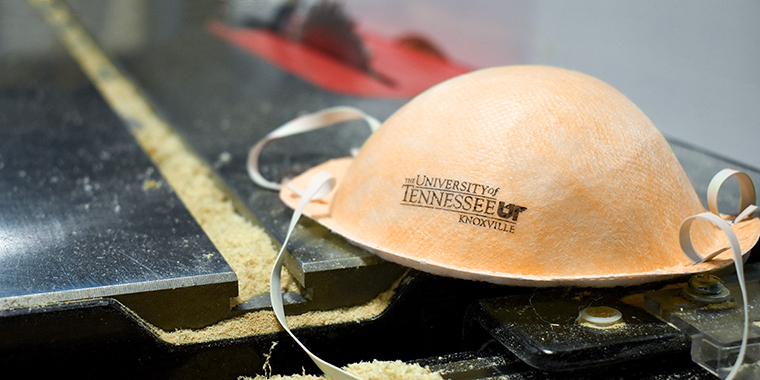
N95 mask from University of Tennessee
According to University of Tennessee, Tsai has 12 US patents and over 20 commercial license agreement, including four licensed to global companies.
"I'm bombarded with questions," says Tsai in an interview with SCMP.
"My customers are based around the world. I work around the clock".
Demand for face masks has skyrocketed.
Tsai came out of retirement to find a way for the N95 masks to be reused. He provided a report which proposed ways to clean and reuse N95 masks without compromising the electrostatic charge required for particle filtration.
He found out that dry heat of 70 degrees Celcius can decontaminate N95 masks without diminishing particle filtration. The method was validated by National Institutes of Health. An oven can be used to decontaminate N95 masks.
On 29 Sep, 2017, the Annual General Meeting of the Licensing Executives Society Malaysia was held. The following executive officers were elected:
President: Michelle Loi
Vice President: Anita Kaur
Secretary: Dennis Tan
Assistant Secretary: Sri Sarguna
Treasurer: Jillian Chia
Committee members: Lim Pui Keng, Eddie Poh, Suaran Singh, Chong Tze Lin
LES Malaysia is the national section of LES International, an organization that advances the business of intellectual property globally.
A key attorney executing BlackBerry Ltd’s (BB.TO) patent licensing strategy has left the company, the second recent departure from the team tasked with making money from the Canadian company’s intellectual property.
Victor Schubert, who was a licensing director for BlackBerry, told Reuters in a brief LinkedIn message that he was no longer with the company. He did not say when he left or why.
Monetizing the company’s intellectual property is a key part of Chief Executive John Chen’s plan for turning around the company whose revenues have declined for six straight years as sales of its once ubiquitous smartphones have tumbled.
Company representatives did not respond to requests for comment on Schubert. Two switchboard operators at the Canadian company said his name was not in a global employee directory.
News of his exit follows the recent departure of Mark Kokes, who lead BlackBerry’s overall patent strategy. Kokes last month joined a health technology company.
Schubert joined BlackBerry in March 2015, according to his LinkedIn profile, as the company was embarking on a major push to boost licensing revenue.
BlackBerry is trying to persuade other companies to pay licensing royalties to use its trove of some 40,000 global patents on technology including operating systems, networking infrastructure, acoustics, messaging, automotive subsystems, cybersecurity and wireless communications.
Schubert has created and executed patent-licensing programs for at least four companies, including BlackBerry, dating back to 1992, according to his LinkedIn profile. It lists portfolio mining, patent valuation and negotiating patent sales as areas of expertise.
He was due to represent BlackBerry at a Seattle-area patent conference next month to discuss how operating companies can make money off their intellectual property, according to an agenda posted on the conference website in August. He is no longer listed as a panelist. - Reuters